Problem Statement
Our class prompt was to design a mobility solution with autonomous technology. Since this is a very open-ended statement, we narrowed down our problem to focus the scope of our project:
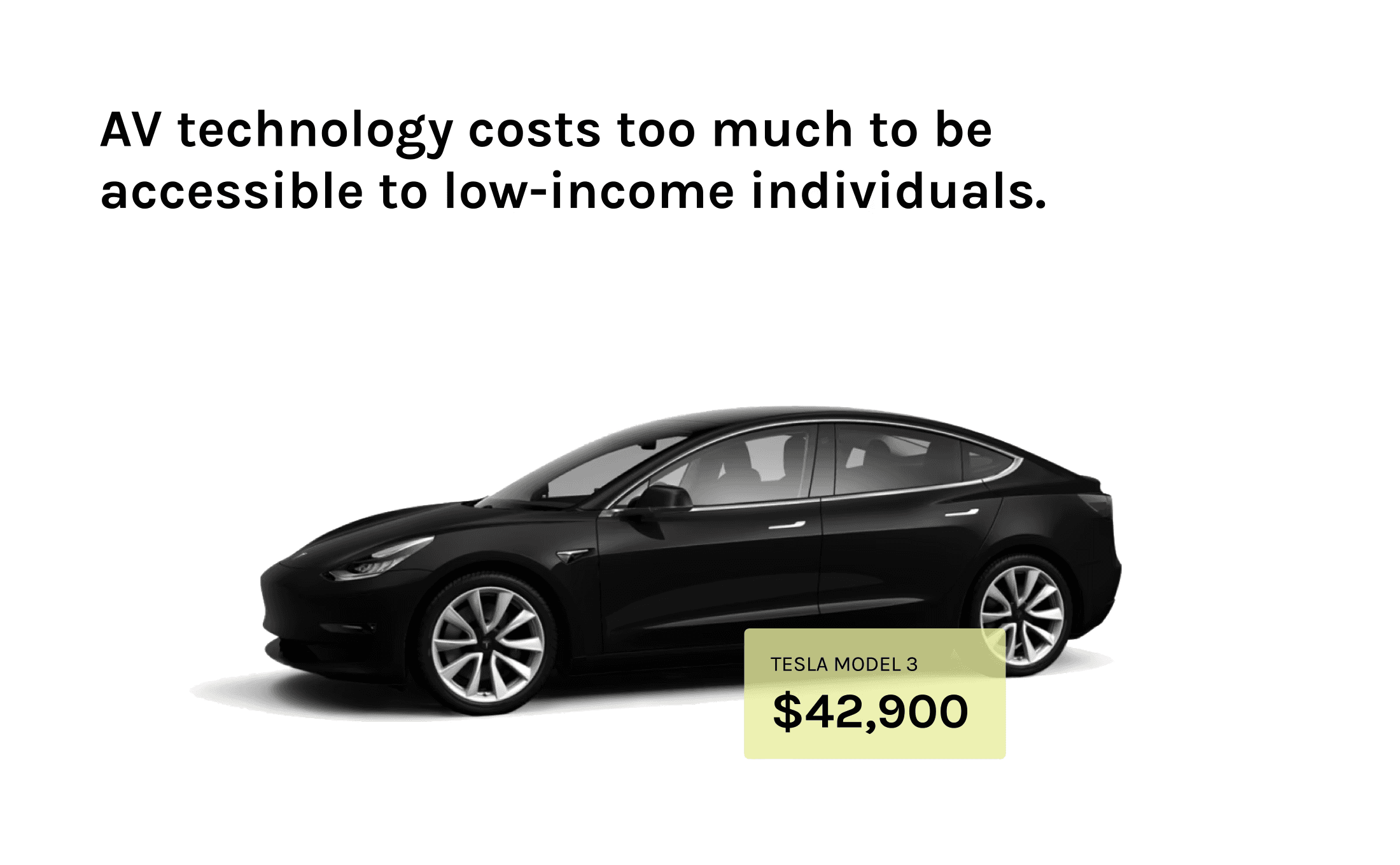
AV technology costs too much to be accessible to low-income individuals.
While this feels intuitive, we wanted to verify this, leading us to conduct user interviews.
User Interview Insights
Our opening round of interviews were very open-ended. We contacted residents of Berkeley, and we asked our interviewee if they thought autonomous vehicles were cheap or expensive. Then, we engaged in free-flowing conversation to gather public perception instead of pre-empt answers.
From our initial round, we gained two significant insights:
Luxury, not necessity: AVs are generally perceived as a luxury, with a high price and exclusivity.
Excludes most individuals: AVs aren't meant to be used by the general public. They're inaccessible because of the high price. Because they are perceived as new technology, people that are late adopters don't consider them seriously.
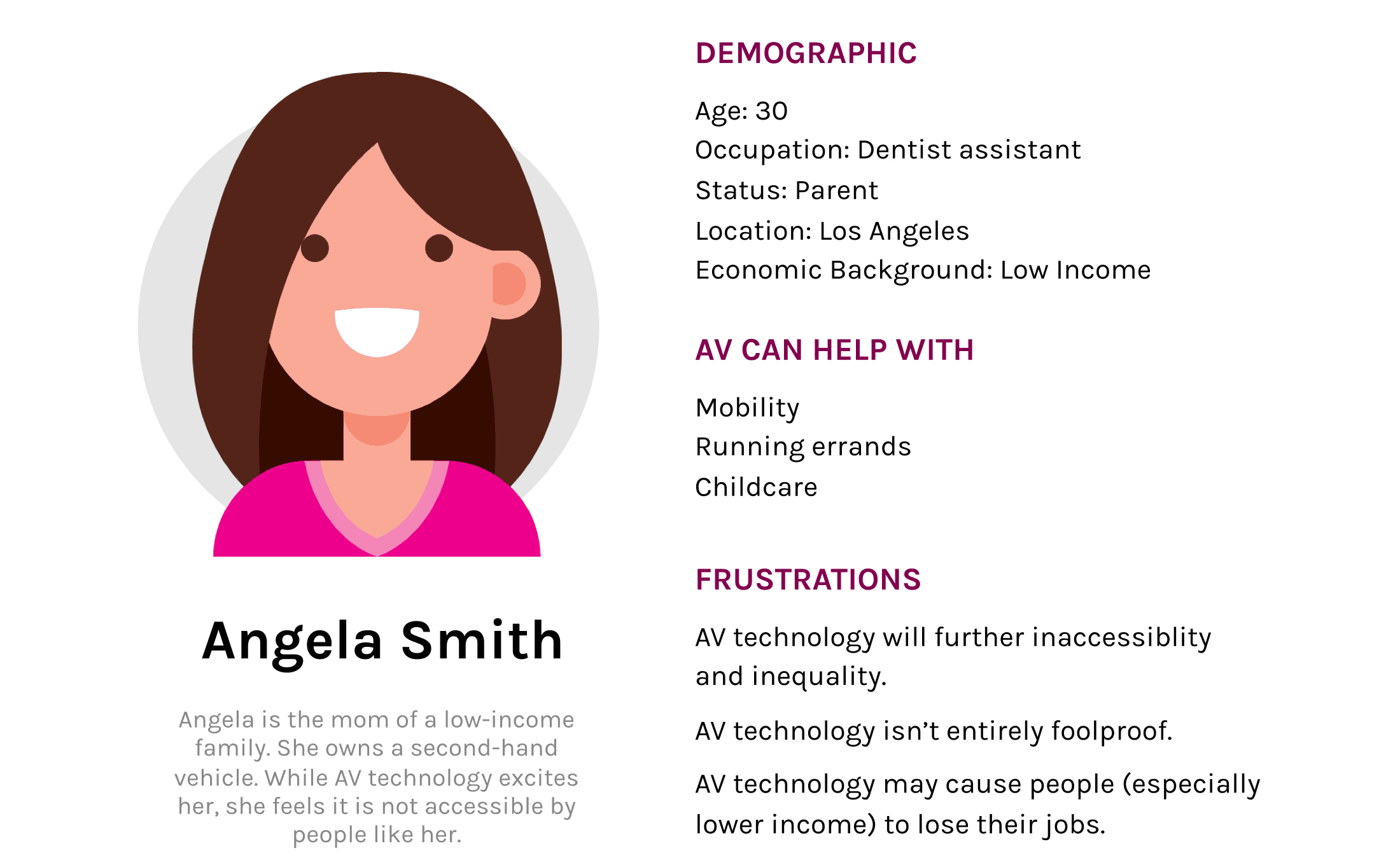
We ended with making a user persona, to guide our ideation.
Ideation
Our user interviews identified gaps in AV services, hinting at what needs we could fill. We formulated 3 statements to guide what kinds of products we would ideate on:
How might we create AV technology for the tech illiterate?
How might we use AV technology to help lower income families with daily tasks like errand running and childcare?
How might we ensure job opportunities for low income communities via the development of AV technology?
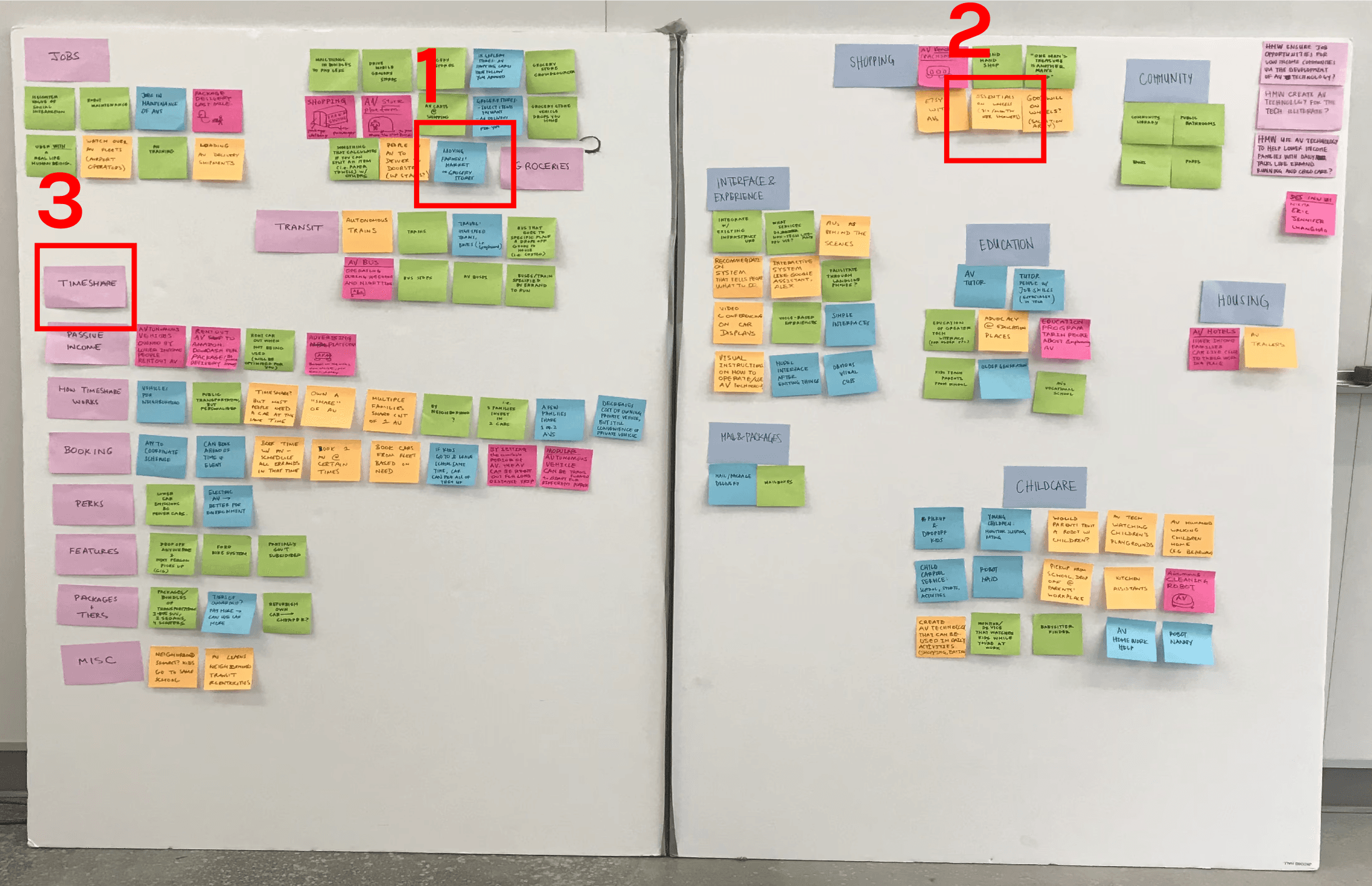
This led to our ideation, where we considered everything from childcare on wheels to mobile grocery stories. We picked our top 3 ideas to sketch out more detailed solutions.
Top 3 One-Pagers
We expanded upon our 3 potential ideas. Creating one-pagers helped us make the ideas more concrete, while remaining concise with our descriptions. The 3 ideas we chose were:
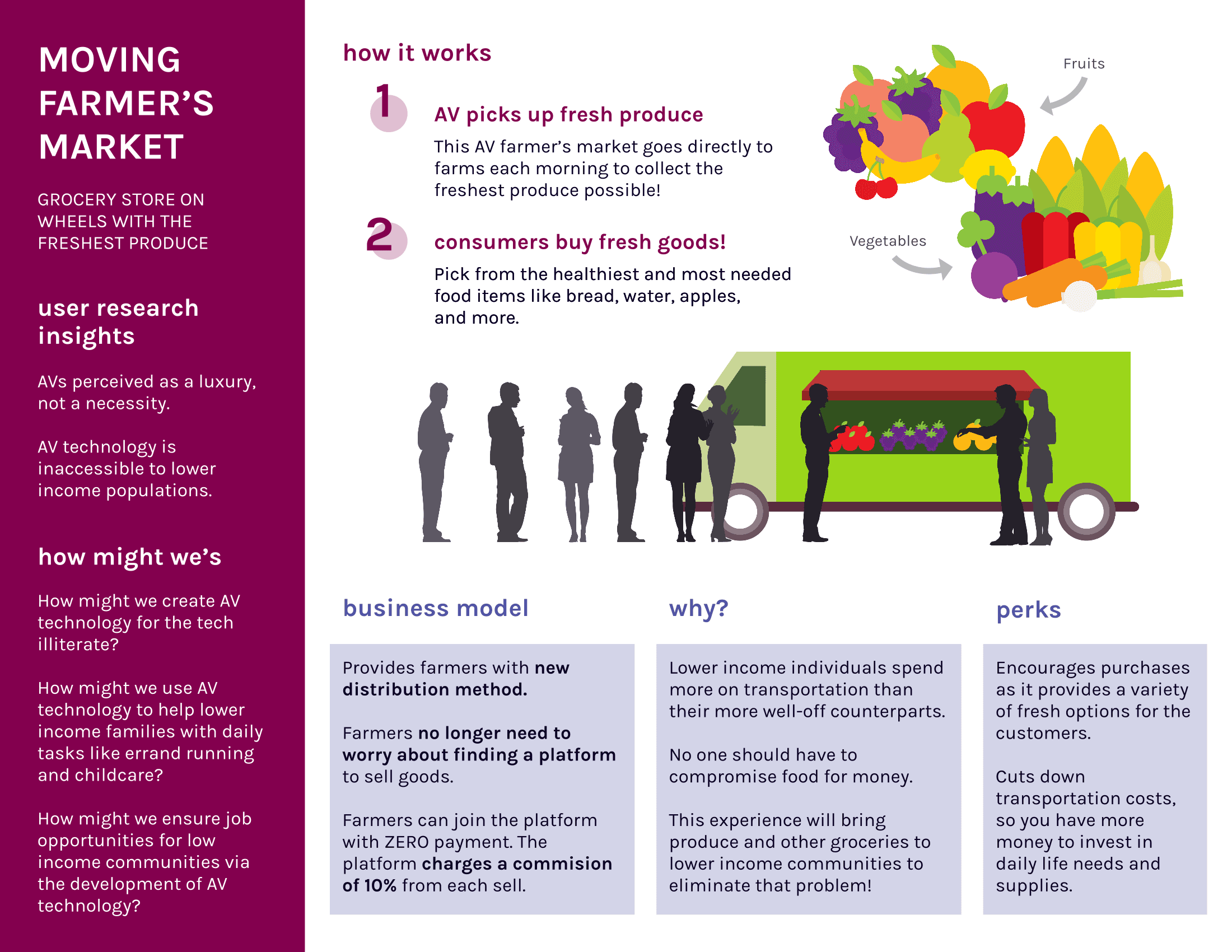
Moving Farmer's Market: We heard often in our interviews about running errands. Right now, we drive our cars on weekends to multiple stores for errands. Delivery provides the convenience of our groceries coming to us, but we can't see them before purchasing. Being able to see and feel groceries was important to our interviewees.
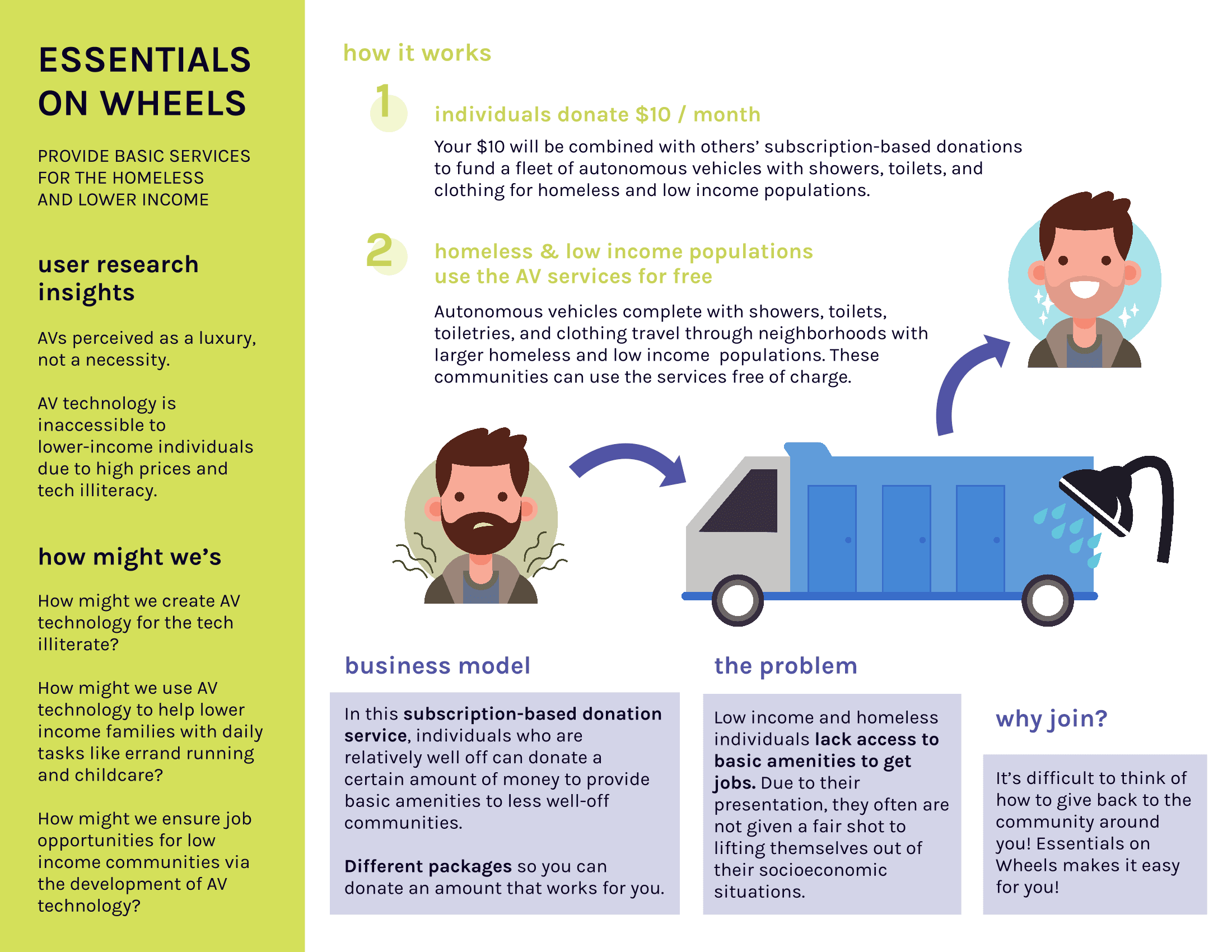
Essentials on Wheels: One lower-income interviewee mentioned the experience of walking up to a social services center and asking about showers. While not immediately obvious to us, we realized there were some feeling of embarrassment. While we can't remove the feeling entirely, a different way to acquire showers, clothing, and other essentials would give people a way to handle their survival needs privately.
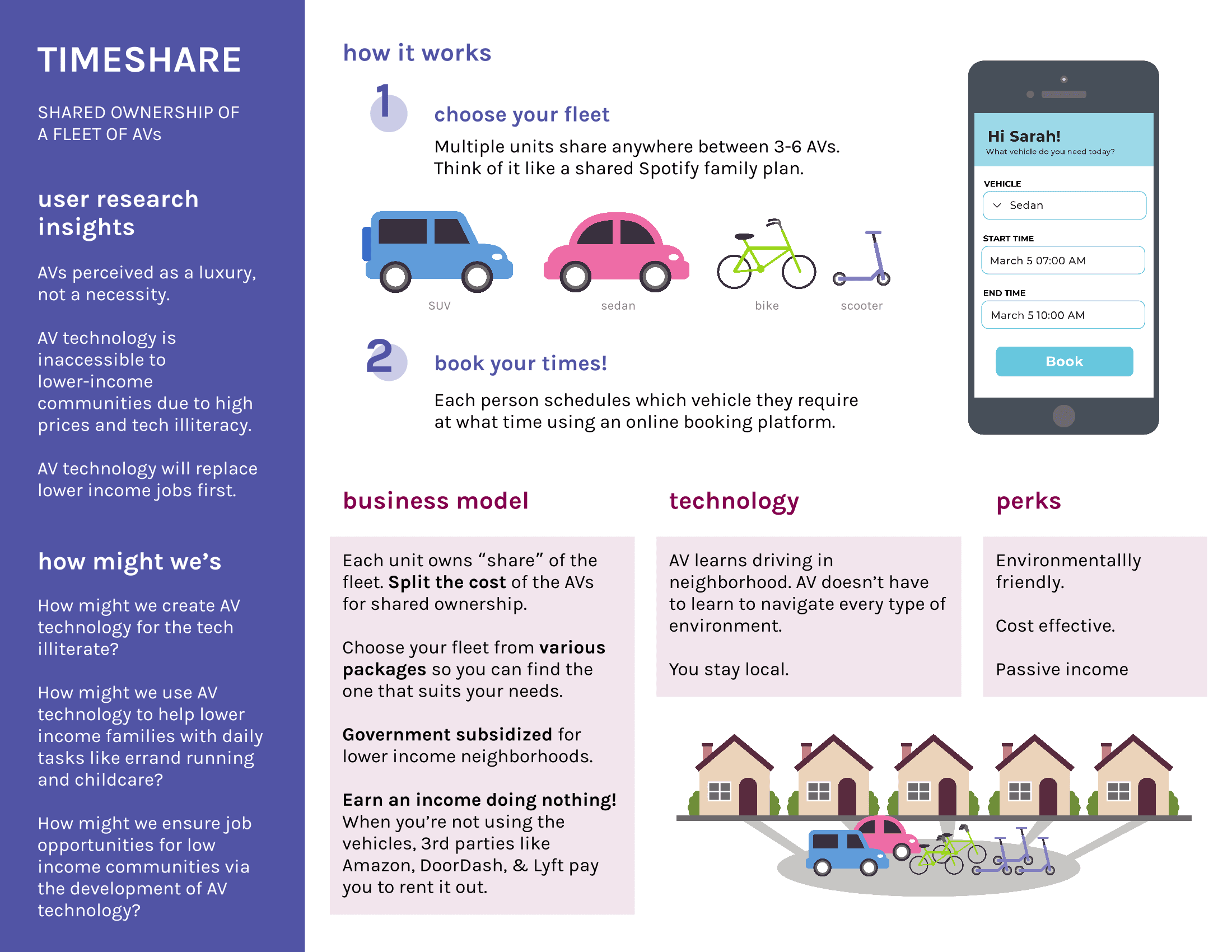
Timeshare: The biggest barrier to entry with autonomous vehicles is price. Whether the vehicles are operated by a rideshare service or owned privately, the technology is too costly for many potential users. Many communities share their resources locally, like arranging carpool groups for their kids and organizing social activities within the neighborhood. We envisioned a community that also shares their transportation needs, with people they know and trust.
After pitching these ideas to some of our interviewees, we concluded that pricing was still an issue with our first 2 ideas. Since price was a primary concern for us, we chose the 3rd idea, Timeshare.
Timeshare
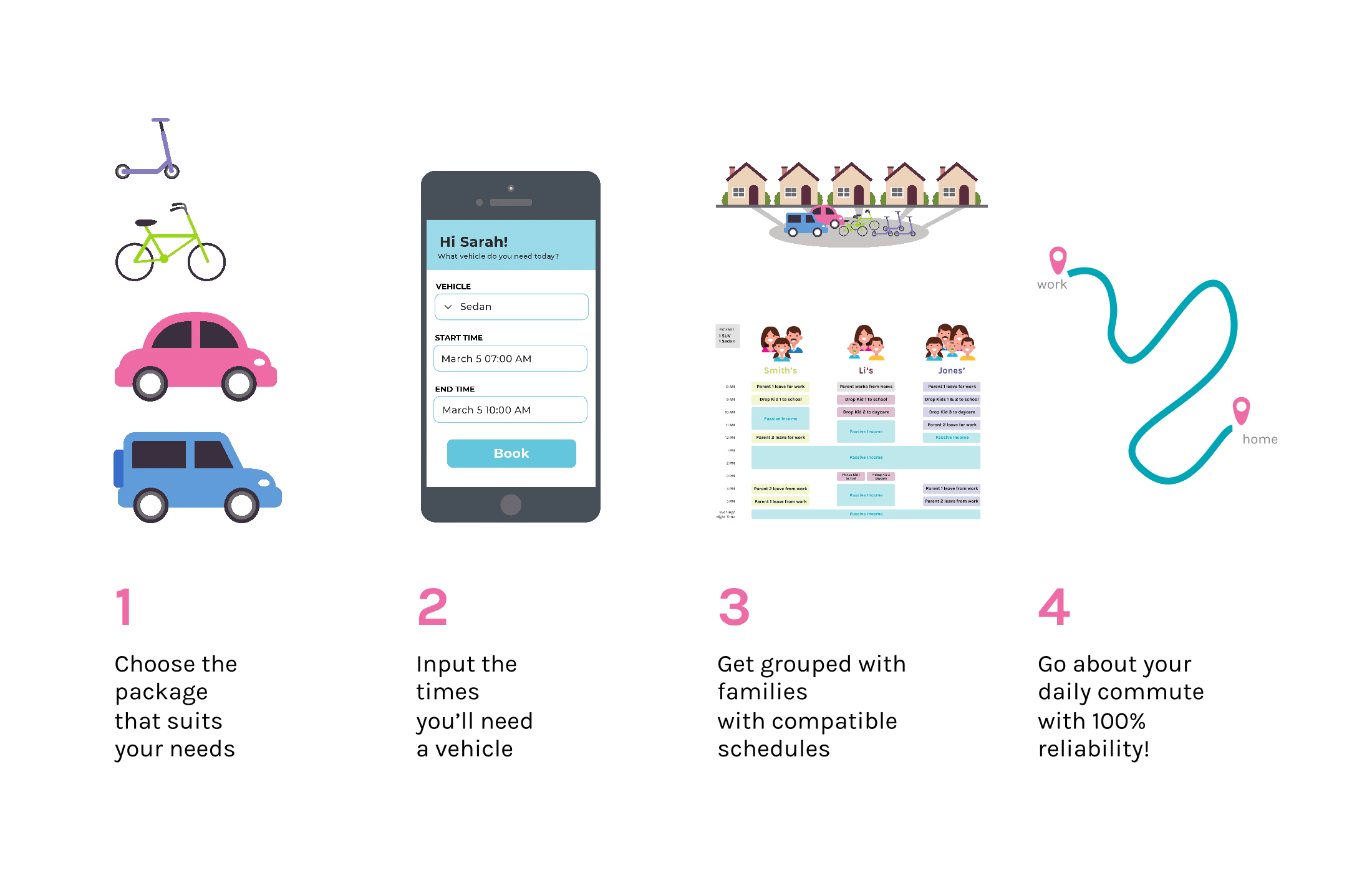
Now it was time to make Timeshare look and feel like a service. Since we could go into every detail without an end, we needed a way to pick out the most important features. We planned out what we would say if we onboarded a new customer, which led to our product description.
Prototyping
While we believed in our solution, we had no idea how other people would react to it! And so we decided to prototype.
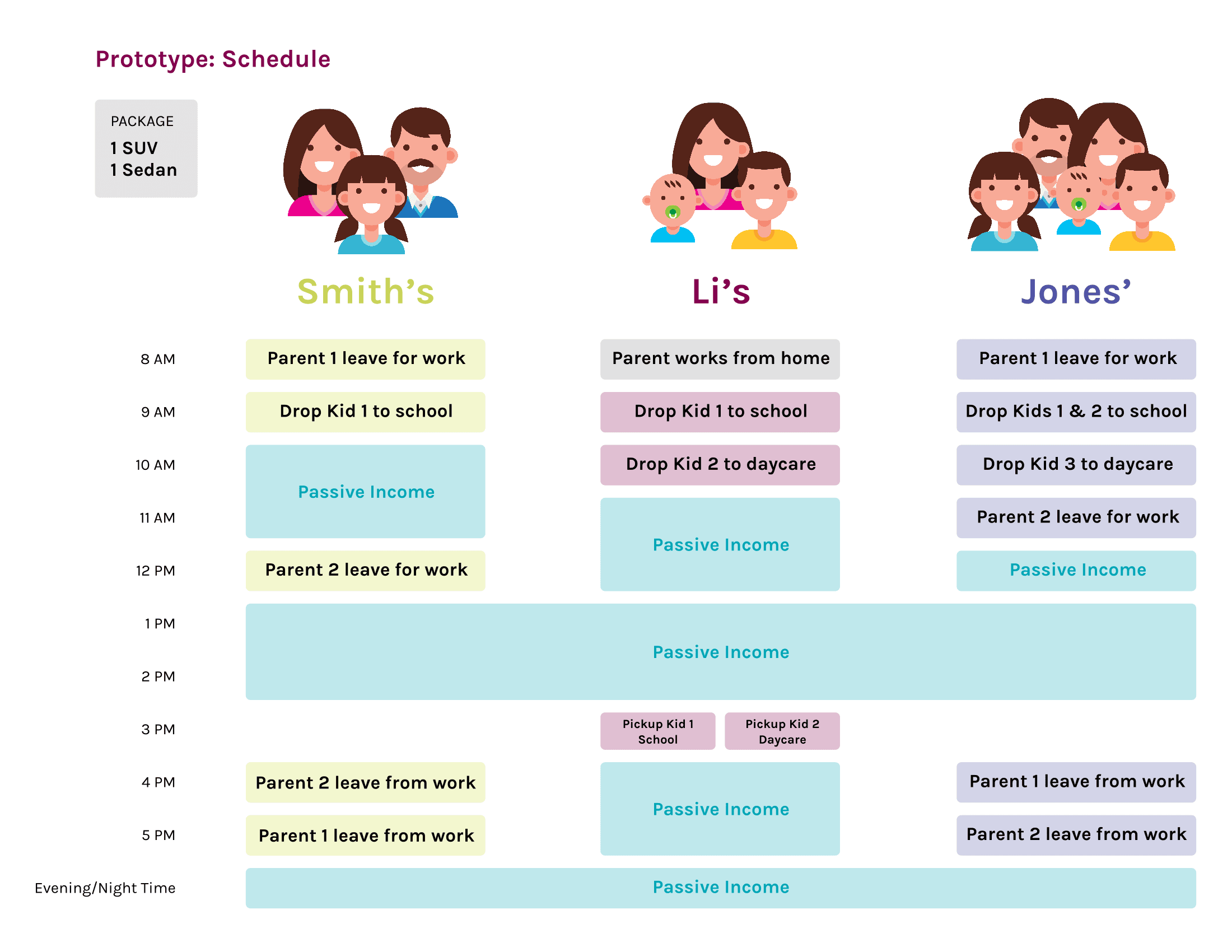
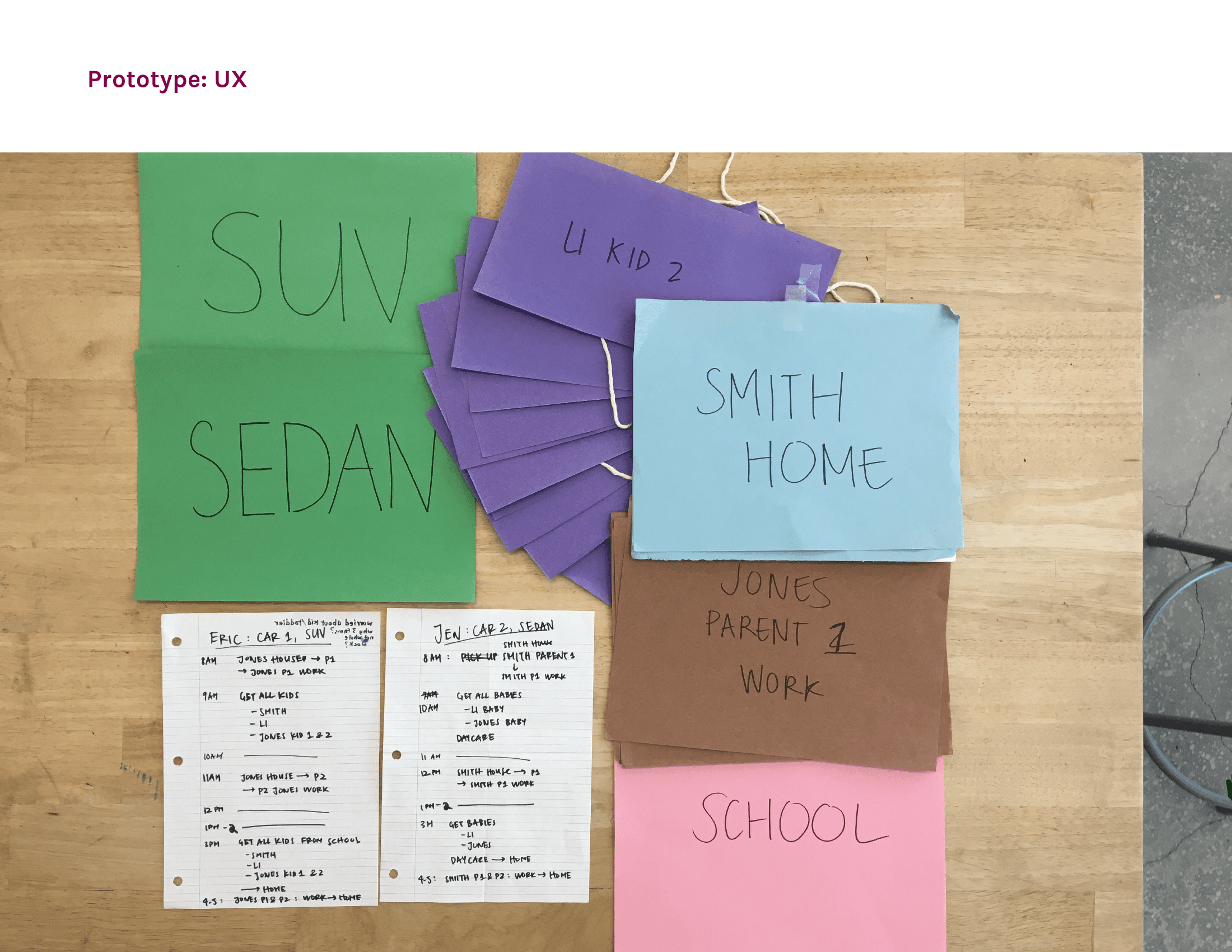
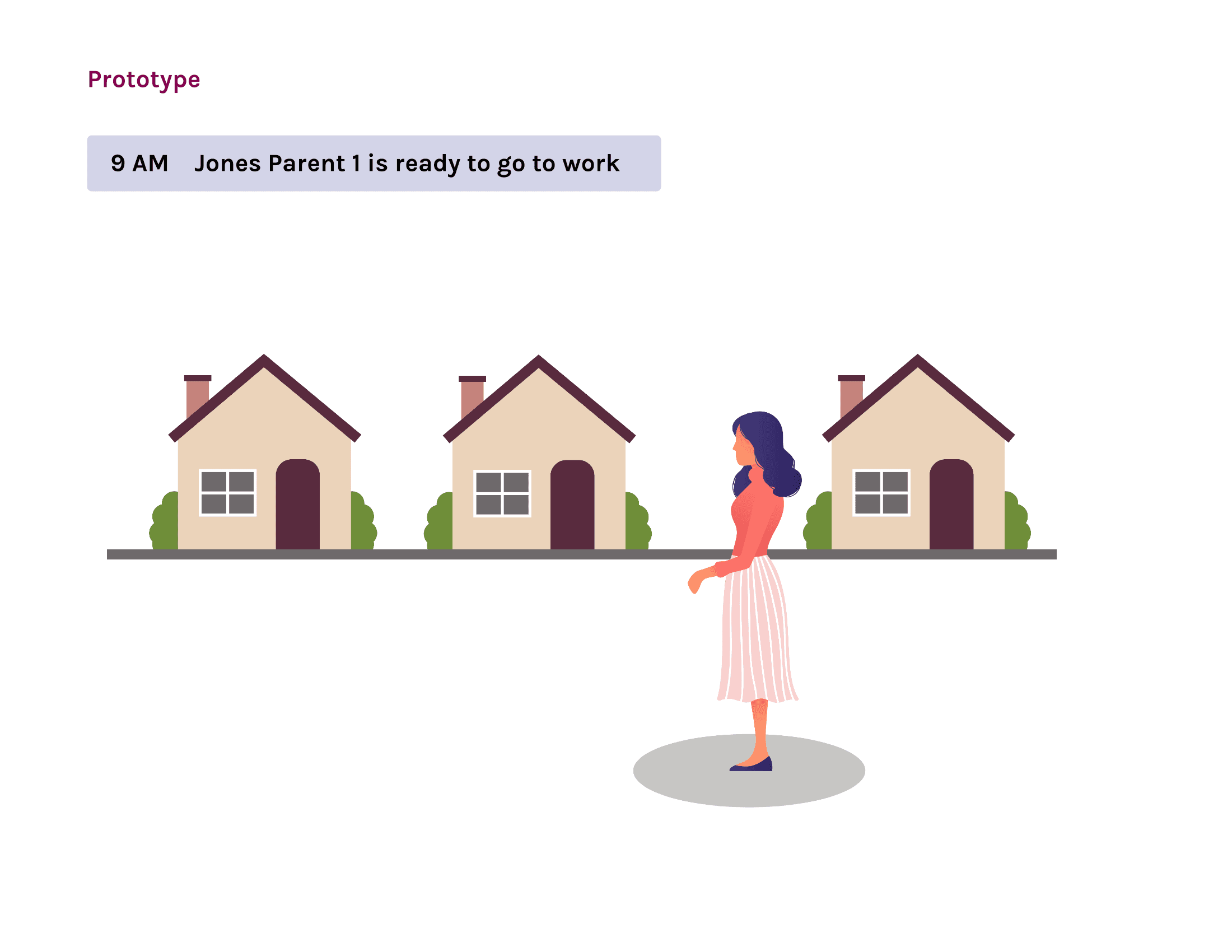
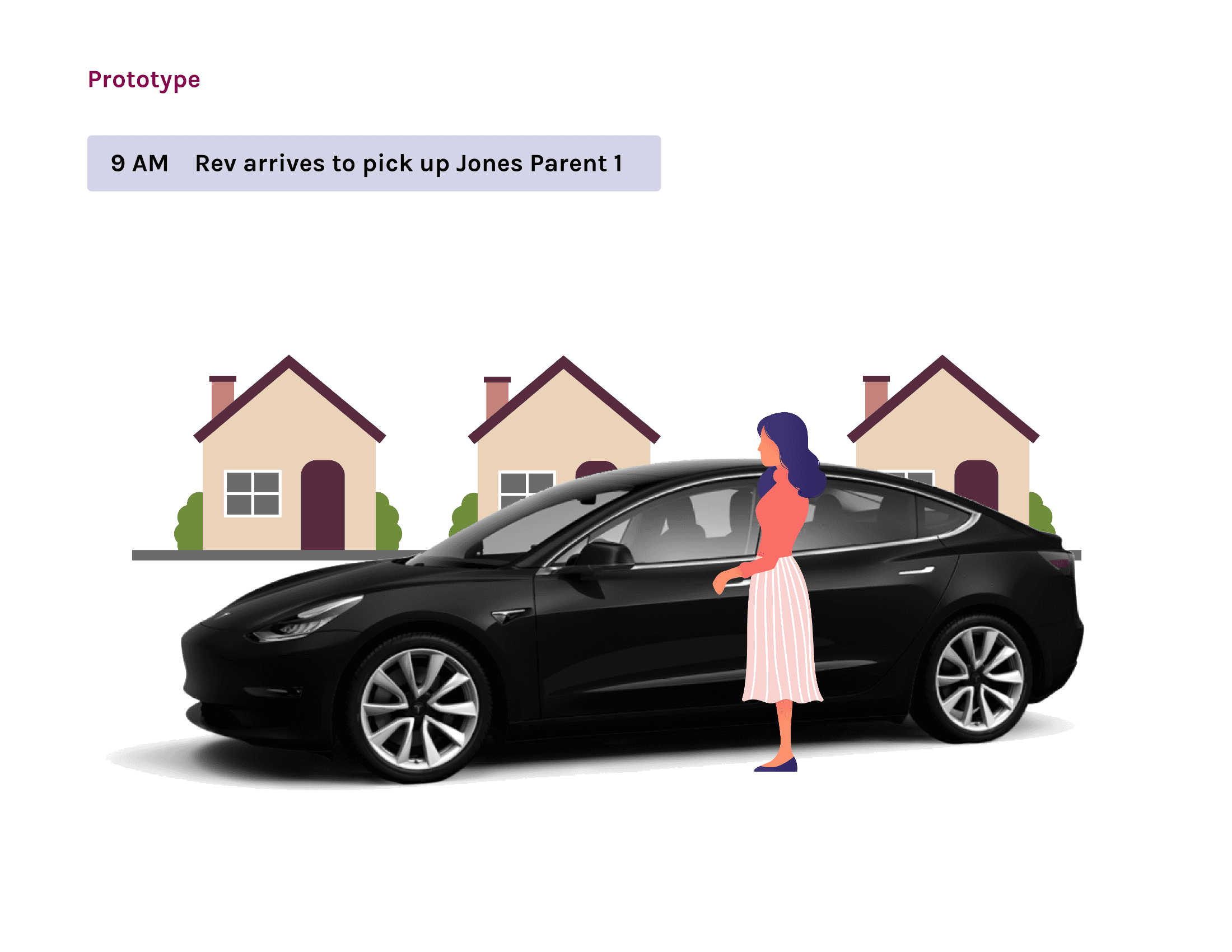
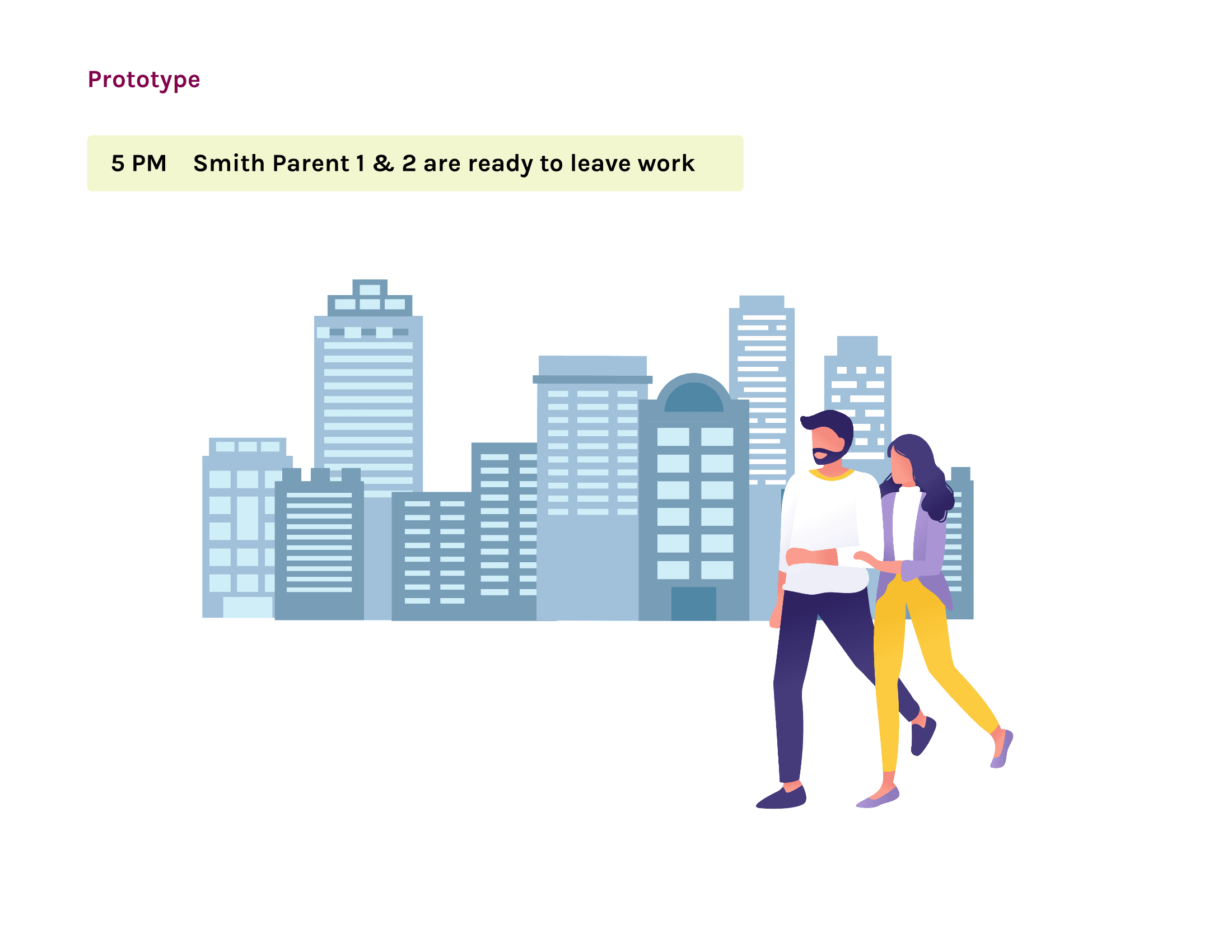
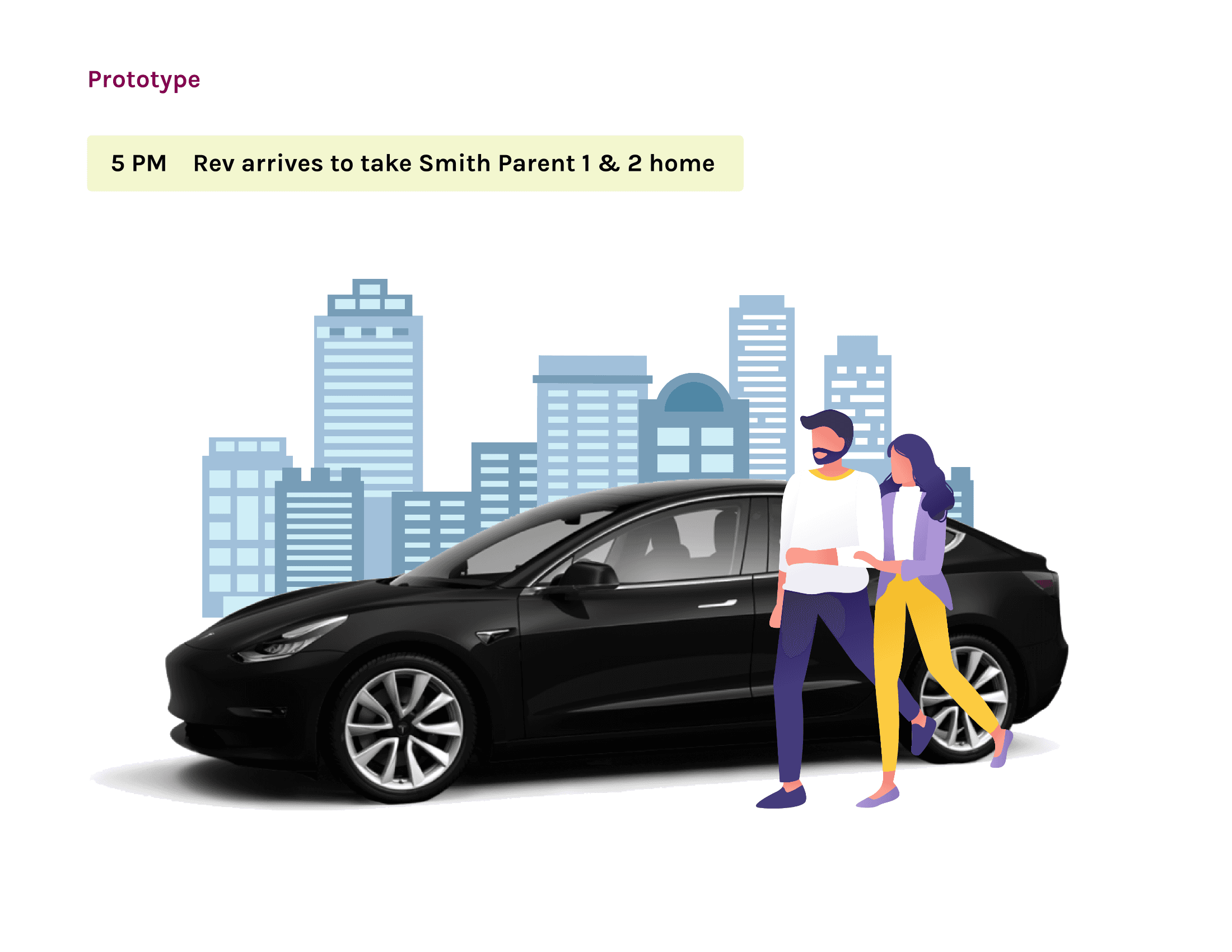
Prototyping the full service would be too complex, and there'd be too many things to keep track of. We decided to mock the scheduling flow. With six people in a room, we assigned roles and provided them a schedule of their "family" routine. We mocked their cars, and moved them around different points in the room, simulating how we would move people around with our product.
Business Modeling
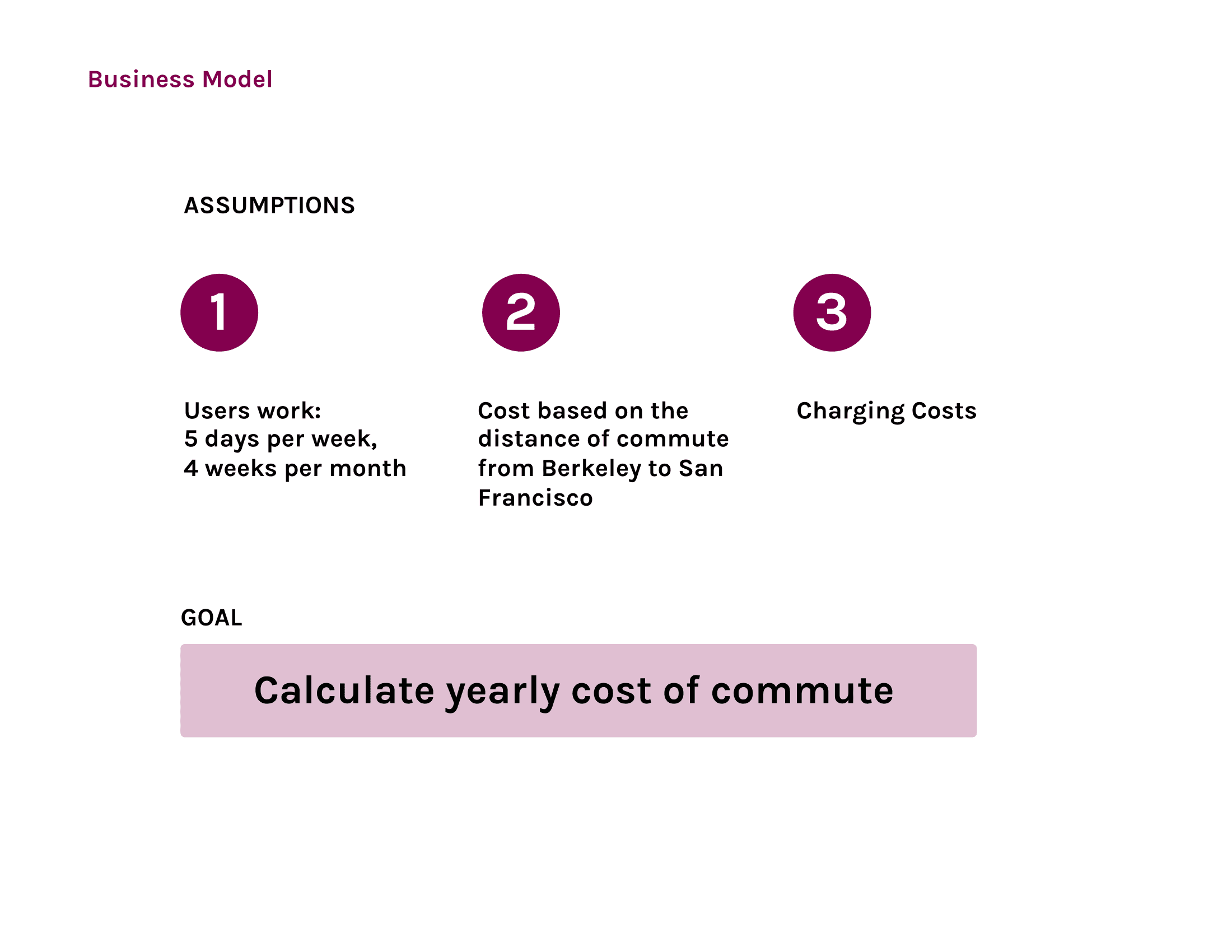
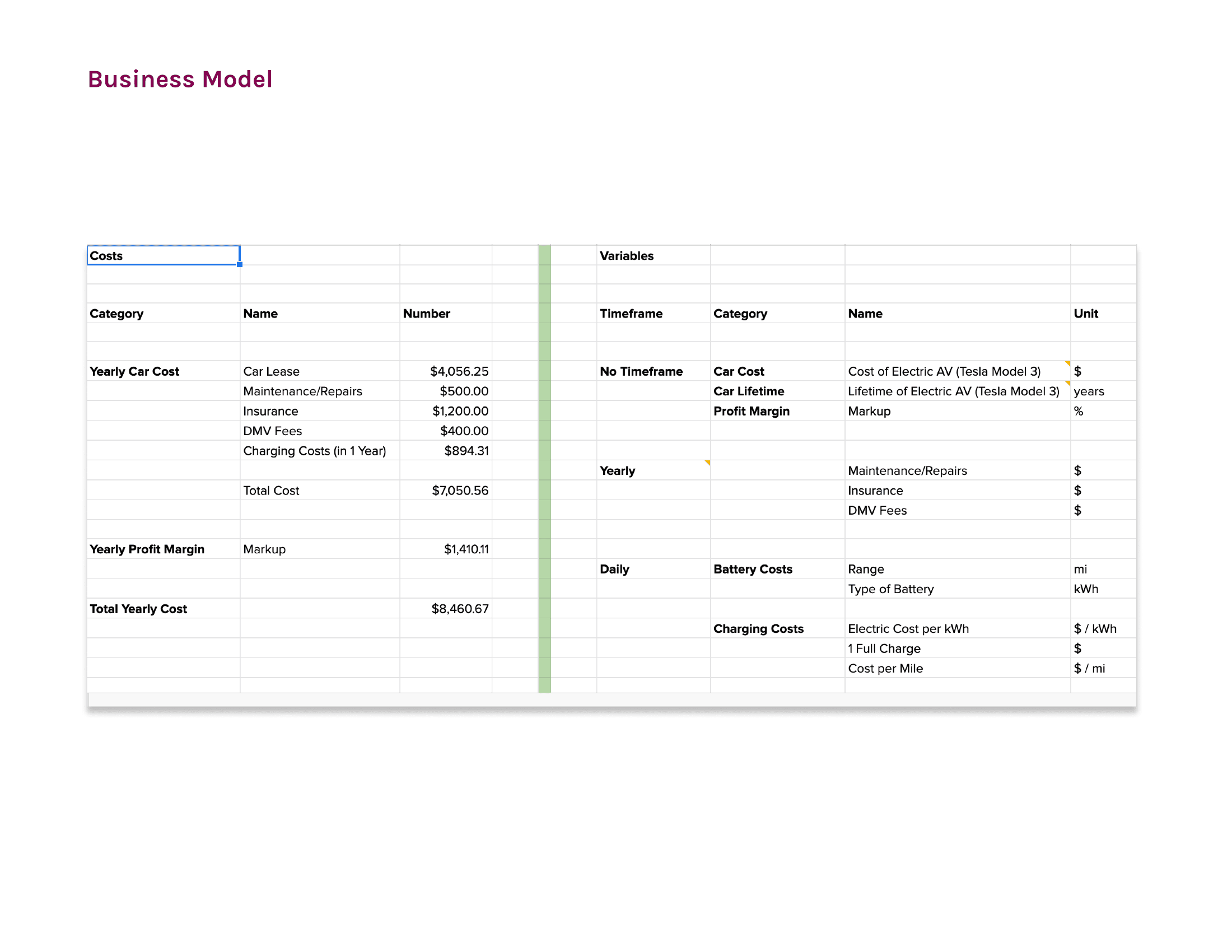
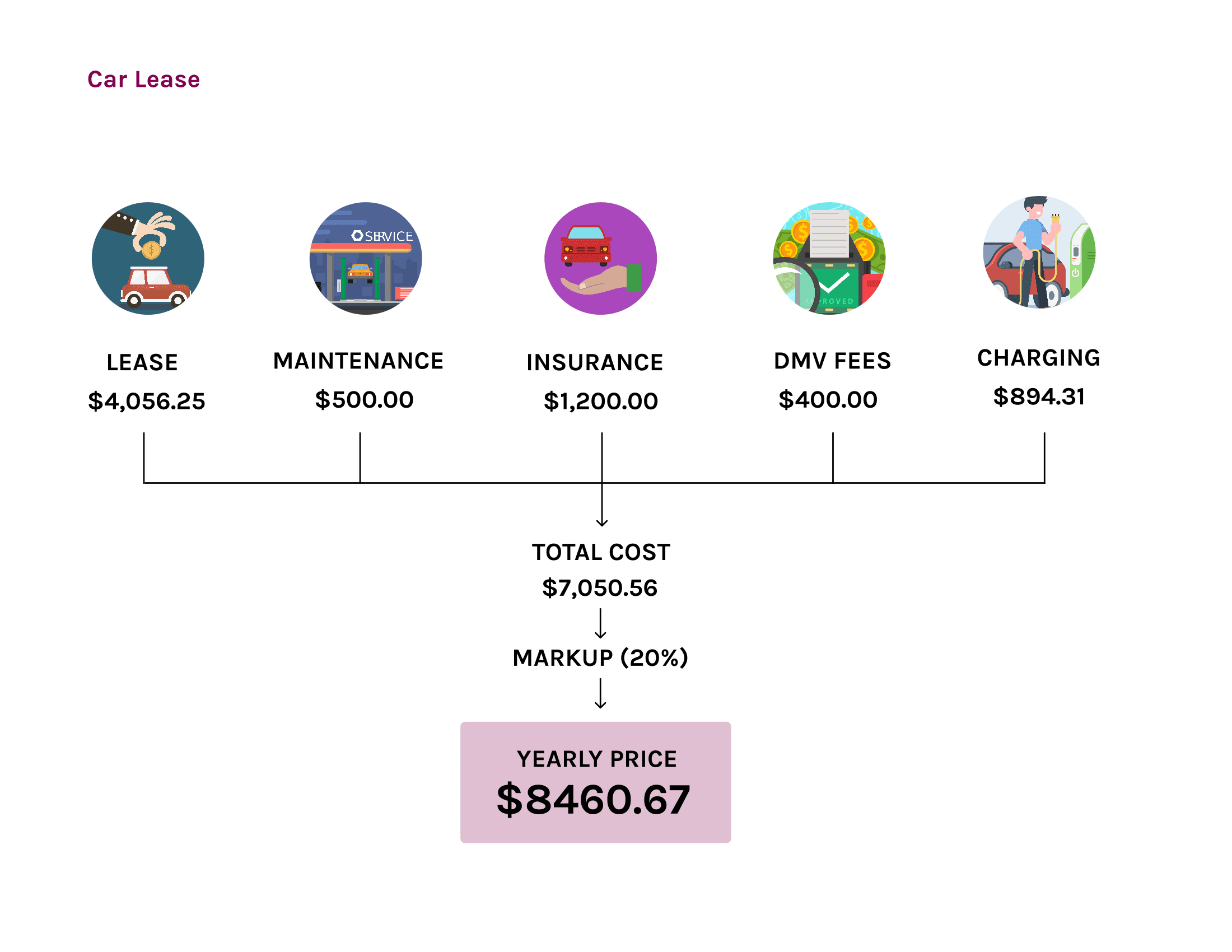
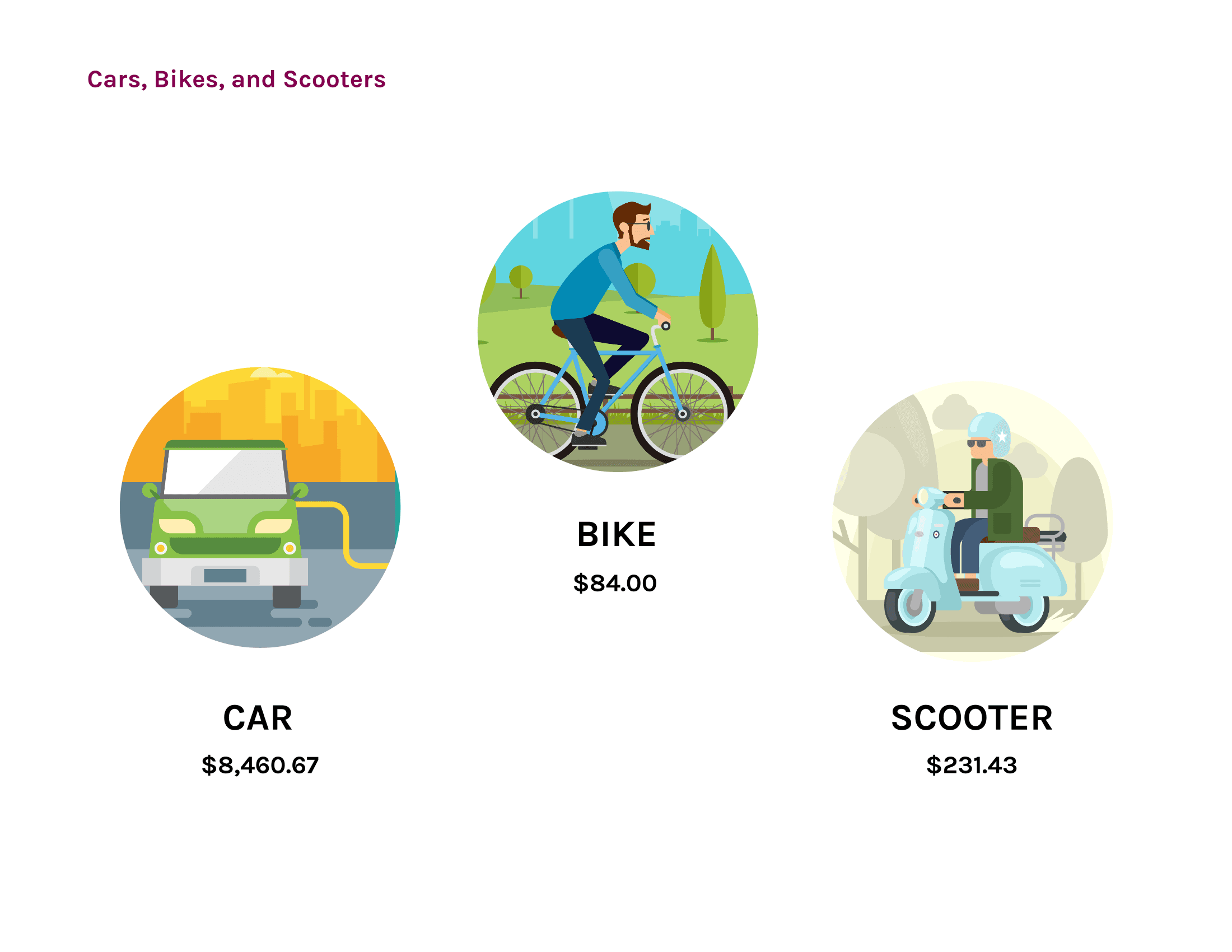
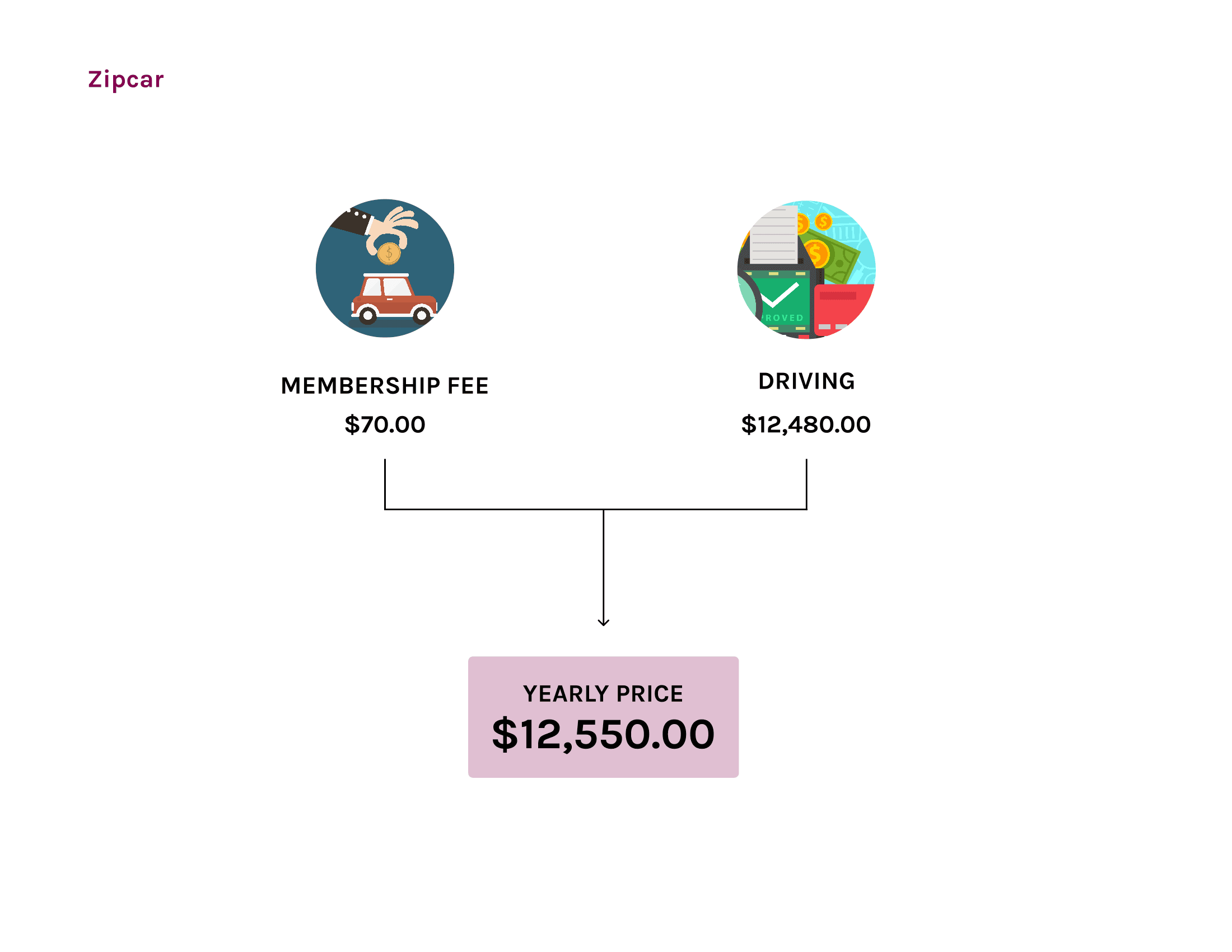
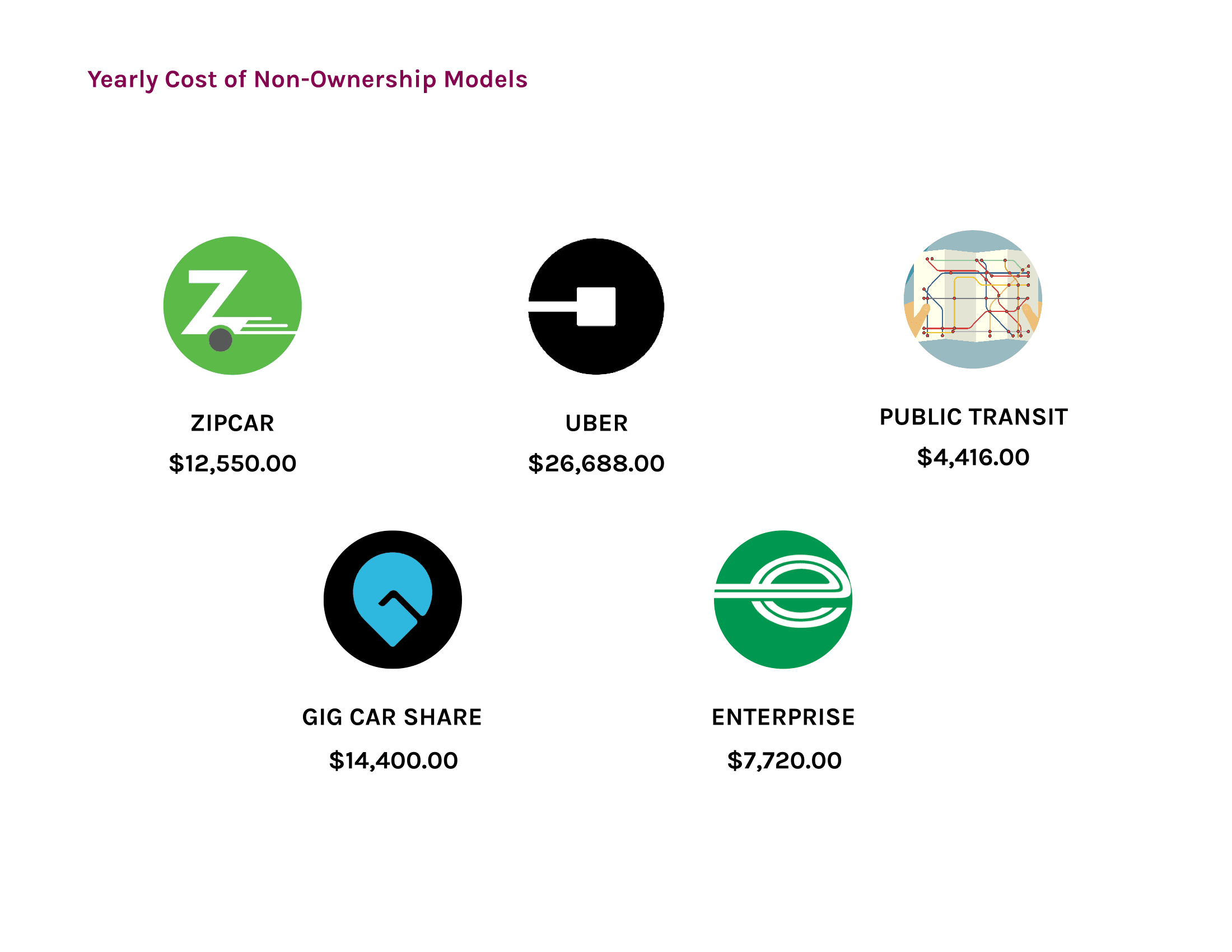
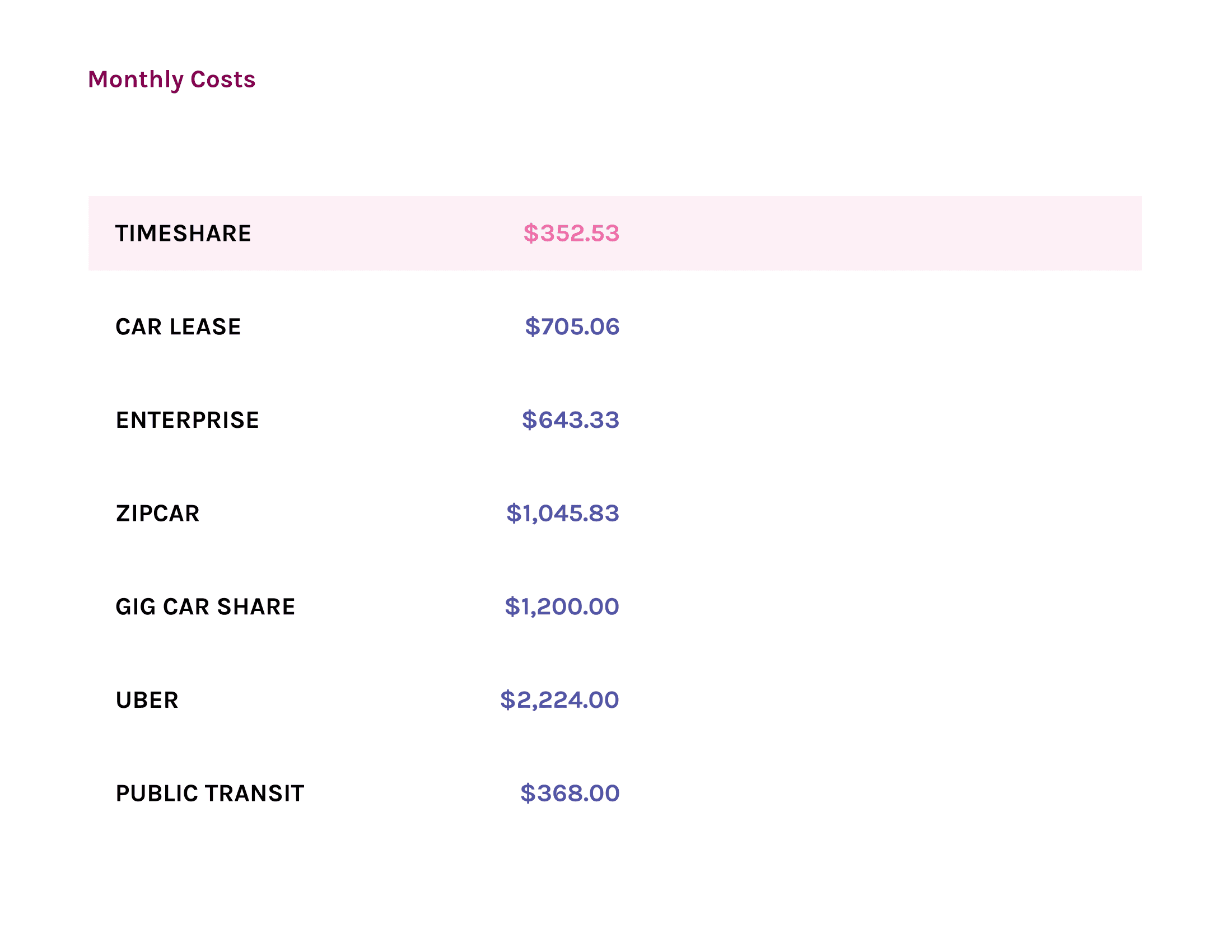
Along with prototyping, we modeled our pricing strategy and compared to other transportation options. Since price was a priority, we polled our prototypers for their reaction to our business model.
To cover what we needed to gain feedback, we calculated the cost for our product to be split among different households. Then, we repeated the same process, but for different options, ranging from public transit to car rentals.
Value Proposition
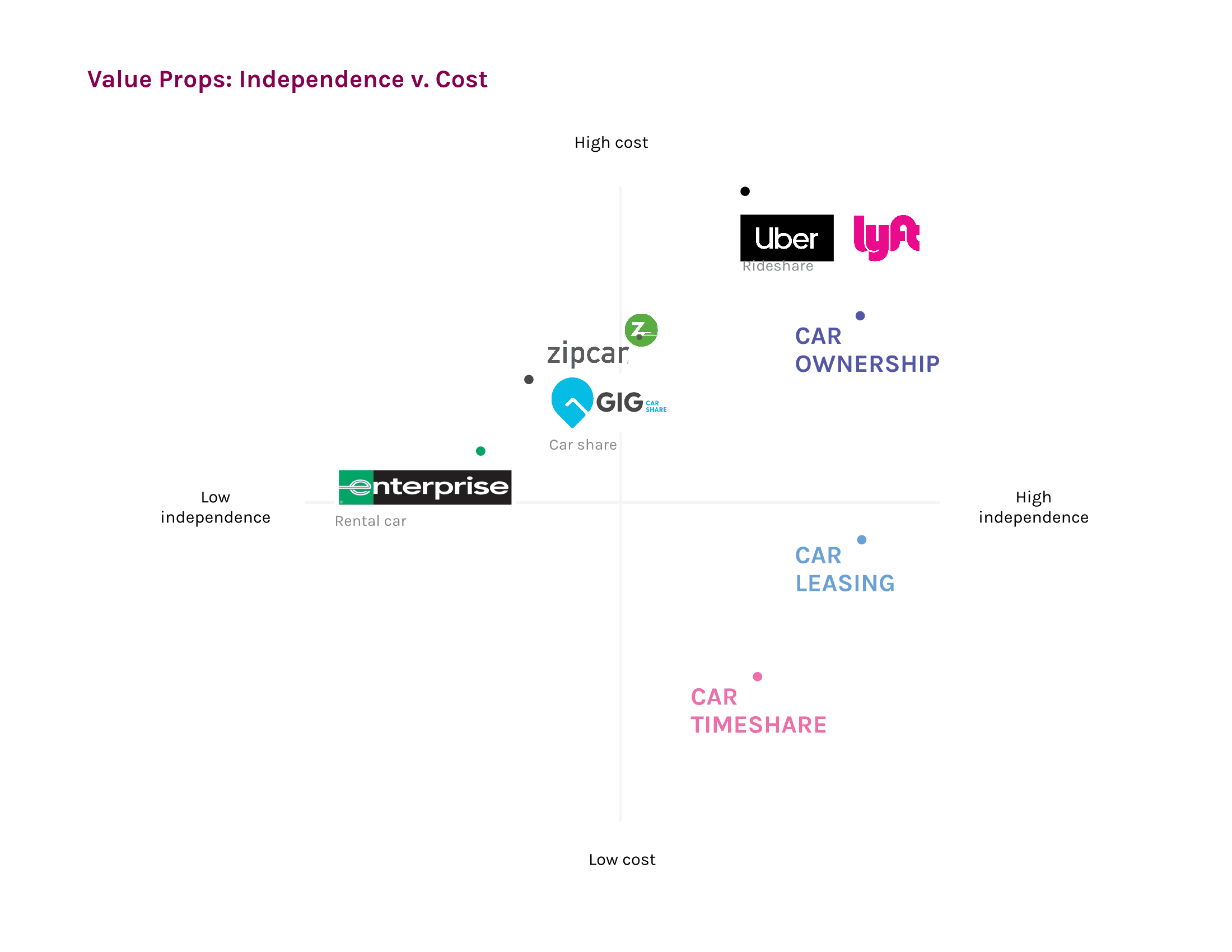
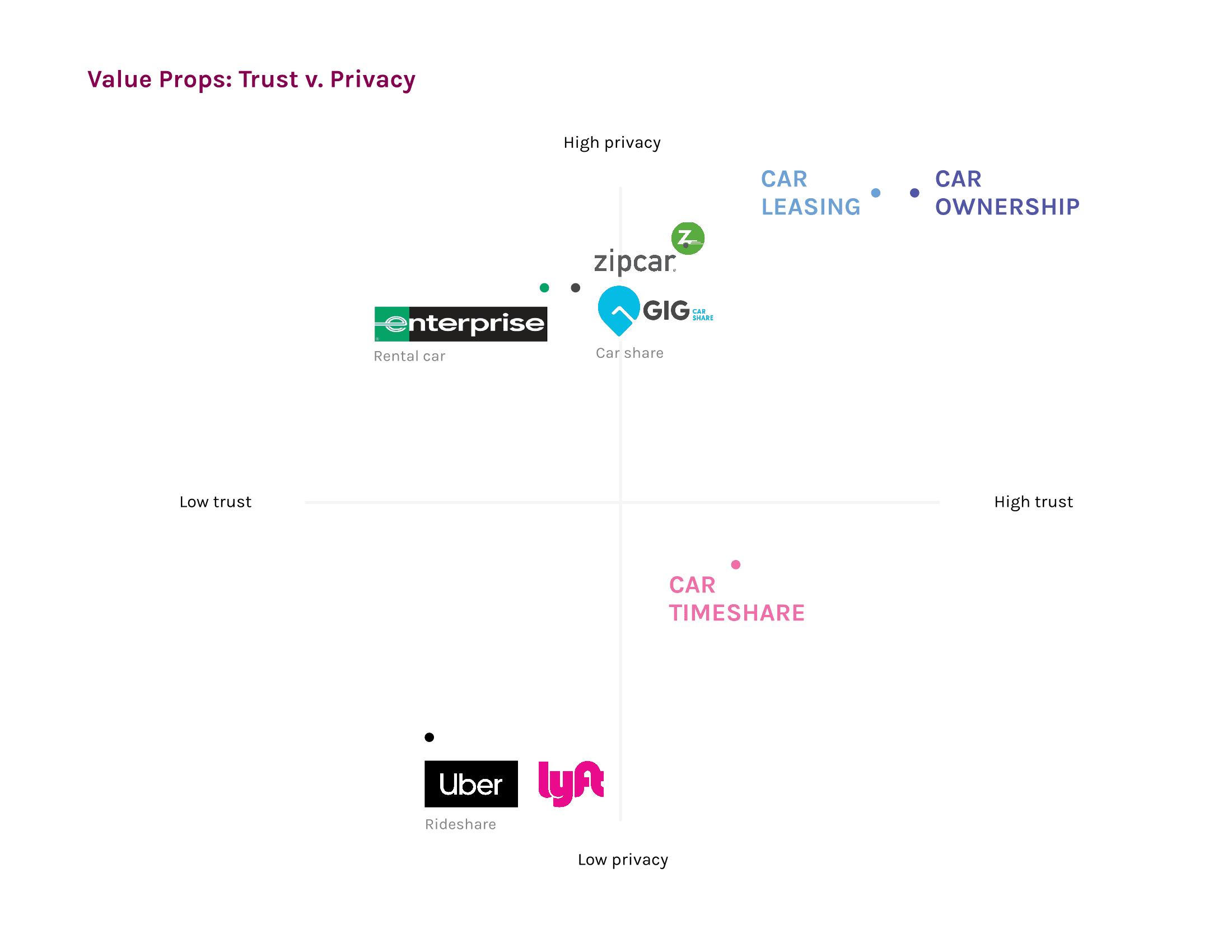
As another exercises to compare our product to existing transportation solutions, we evaluated Timeshare's value proposition on independence, cost, trust, and privacy. This gave us confidence that our pricing was moderate for the value that Timeshare provides.
Future Iterations
In an ideal world, we'd continue iterating until this became a tangible, real product. We conducted interviews with our prototypers after our session with them. From our interviews, we gained a few takeaways:
Most interviewees liked the idea of sharing a car. It felt like a bus, but local to people they knew.
There were edge cases that our interviewees were concerned about. What happens if the car is in an accident? Can I reserve the car in an emergency?
All interviewees supported the idea of a nice AV offered to people outside of the high-income bracket. Some wondered if nice things in a low income neighborhood would be treated well, or if we would allow physical payments for our product.
With each of our insights, we gained some perspective of our users, as well as their next questions, which leads nicely to future iterations.